 RYZE AI Suite AI solutions for efficiency and productivity

Marketing automation for a positive communication experience - no fobbing off with empty phrases
Date
 Corporate Reporting Holistic reports with impact and efficiency
  Sustainability Effective communication of sustainability
  Internal & External Communications Communication that moves people
  Employee Experience Communication that brings people together
  Film & Animation Studio Films and animations that convince
  Digital Experience Platforms & Websites Websites and platforms for strong brands
  Social Media & Performance Marketing Campaigns that deliver results
  CRM, marketing & sales with HubSpot Consultancy and systems for your growth
  Product & Digital Data Services PIM & DAM solutions for consistent product data
As in every industry, automation in marketing is also suspected of taking away jobs. It also has a reputation among some for fobbing off interested parties with generic, ready-made information and thus diminishing the user experience. In reality, however, this is not the case! A well-thought-out automation strategy ensures a positive communication experience for the user and certainly doesn't make anyone redundant.
Even if the word "automation" might give the impression that the processes run by themselves and you have nothing more to do with them because the system can think or learn for itself, so to speak, this is by no means the case. We are not talking about an artificial intelligence that looks at the behaviour of visitors to your website and triggers appropriate reactions or suggests further content.
In marketing, automation rather means that predefined, thematically coordinated reactions to previous actions take place, predefined by you, set up in the system by you and analysed and optimised - you probably already guessed it - by you.
You are responsible for defining the process and creating the subsequent offers. It is also your job to set up, analyse and, if necessary, optimise the processes in the marketing automation system.
This means that you are by no means superfluous in the automation of your marketing communication, but retain control over the automated processes.
This is not true, but only if you send information that is irrelevant to the contact.
To ensure that your automated responses are really relevant for the user, you need to know them or the buyer persona beforehand, as is usual in inbound and content marketing. Based on this knowledge, you develop content offers that are staggered according to the funnel stages and thus turn a visitor into a lead and, ideally, ultimately into a customer.
The development of offers (e.g. white papers, videos or infographics) and the definition of the time periods in which a lead receives this information are entirely up to you. Automation only kicks in once you know a lead's interests and can provide them with information according to their thematic interests.
So you will be working with ready-made texts, yes. No-one who works with a marketing automation system can absolve themselves of this.
What is really important here, however, is that the information must be tailored to the interests of the contact. Let's assume you have offers on the following three topics:
If a visitor to your site now downloads something on the topic of blogging, they will only receive offers on the topic of blogging (if you have set up your automation accordingly, which we are assuming here).
This could be links to other helpful content, the offer of another free download or much more. Your buyer persona will certainly provide you with guidelines as to which format is worthwhile.
The user experience is designed positively based on the thematically relevant information - even with ready-made processes and texts.
No. Spam is the unsolicited receipt of unwanted advertising emails.
However, marketing automation goes hand in hand with the use of a double opt-in procedure. This ensures in the system that you cannot send anyone an e-mail without their consent.
In addition, the emails are not only thematically customised, as described above in terms of inbound and content marketing , but above all they are not promotional at all. You send relevant content from which the contact can learn something - without price details and without feature lists, indeed for a long time without even mentioning your products.
Last but not least, the entire period and frequency over which you nurture your leads is based on the buyer persona and how long it takes for their information procurement and purchasing process to be completed. You divide precisely this period into intervals in the marketing automation system and send your emails accordingly.
If someone has not carried out a predefined number of actions within this period of time, they are automatically (and again predefined by you) marked as not interested and removed from the process.
Of course, a contact can unsubscribe from receiving emails at any time. Most systems no longer allow emails to be sent without such an unsubscribe link.

A deep understanding of buyer personas is essential for the successful implementation of digital and automated processes. All information summarised in an easy-to-understand white paper.
This is not to say that using a marketing automation system can be done by hand. Done correctly, it definitely takes up a lot of time at the beginning. After all, you no longer have to manually thank leads for their interest in the company or enter a reminder in your calendar to send the next content offer to a specific group of your contacts on time.
This runs as predefined by you.
After the initial setup, you have more time to devote to analysing and, if necessary, optimising current processes and, of course, other tasks.
And - most importantly:
They cannot be replaced by a marketing automation system.
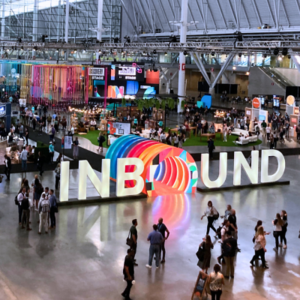
Every year, HubSpot brings together a wide range of experts from the fields of sales, marketing and customer experience at the Inbound trade fair. We also attended the event in Boston and asked around and exchanged ideas about what contemporary marketing looks like and what new tips and tricks we can use to inspire our customers. What particularly moved marketers this year? Specialist presentations, customer-centric strategies and the power of storytelling were important topics, but none were given as much space as artificial intelligence.
More information

The potential of artificial intelligence goes far beyond the creation of images, text and audio: new types of AI can take on central roles in corporate
communication. In our new blog article, we show the advantages of this in practice and what companies need to bear in mind.
More information

Hardly any other topic is currently being discussed as intensively as artificial intelligence. Tech companies are in a gold-rush mood: billions of US dollars are being invested, new AI models are being publicly tested and areas of application in companies and society are being developed. As a digital agency, we are not only at the centre of this transformation, but also at the forefront of the technology revolution with our own solutions.
More information