 RYZE AI Suite AI solutions for efficiency and productivity

EmpCo makes clear statements in support of green causes
Date
 Corporate Reporting Holistic reports with impact and efficiency
  Sustainability Effective communication of sustainability
  Internal & External Communications Communication that moves people
  Employee Experience Communication that brings people together
  Film & Animation Studio Films and animations that convince
  Digital Experience Platforms & Websites Websites and platforms for strong brands
  Social Media & Performance Marketing Campaigns that deliver results
  CRM, marketing & sales with HubSpot Consultancy and systems for your growth
  Product & Digital Data Services PIM & DAM solutions for consistent product data
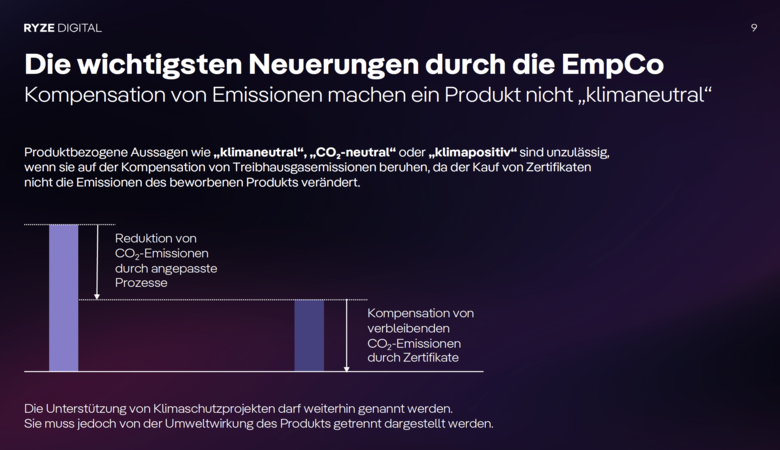
‘Environmentally friendly’, ‘sustainable’, ‘climate-neutral’. Terms like these are easy to write and make people feel good. However, anyone advertising environmental benefits must be able to demonstrate them transparently. Stricter rules on this will come into force on 27 September 2026. The European EmpCo Directive will therefore also change the day-to-day reality of product and corporate communications.
Greenwashing begins when the green promise exceeds the actual environmental performance. This does not require a deliberately fabricated story. Even imprecise wording or a single benefit that makes the entire product appear better can create a misleading impression.
A study by the European Consumer Protection Network (CPC) shows just
how widespread problematic claims are. Of 344 environmental claims selected as dubious, more than half lacked sufficient information to assess their accuracy. 37 per cent contained vague terms such as ‘environmentally friendly’ or ‘sustainable’. The European Commission published the findings in 2020. They were one of the reasons for addressing the issue of ‘green’ communication.
EmpCo stands for ‘Empowering Consumers for the Green Transition’. In Germany, the guidelines on environmental advertising are enshrined in the Act against Unfair Competition (UWG). The guidelines are intended to enable consumers to make more informed purchasing decisions. Among other things, they cover claims regarding environmental and climate benefits (‘resource-efficient’, ‘environmentally friendly’) as well as sustainability labels. In addition, there are requirements concerning, for example, the durability and reparability of products.
Communication with customers and consumers is
crucial. It is the overall impression that counts. Images, symbols, product names and logos can also convey an environmental message. A green leaf next to a product name therefore deserves just as much attention as the text below it.
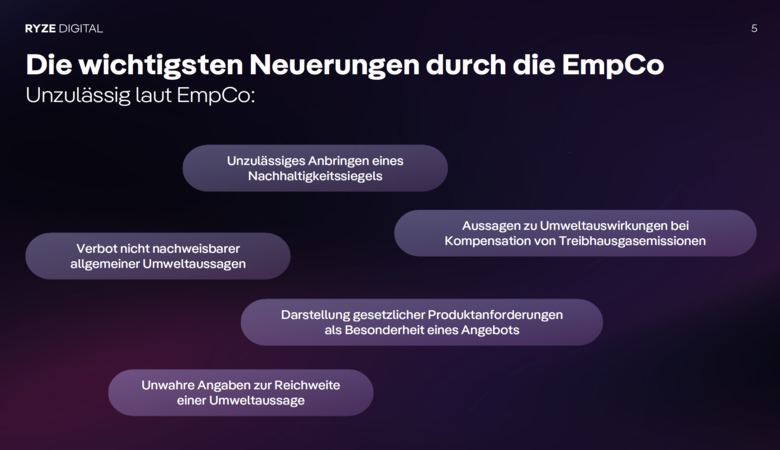
These five points are particularly relevant to communication practice.
Promises for the future also warrant attention. Anyone advertising a future climate target, for instance, must have clear and verifiable commitments as well as a detailed, realistic implementation plan. This also includes regular review by independent experts.
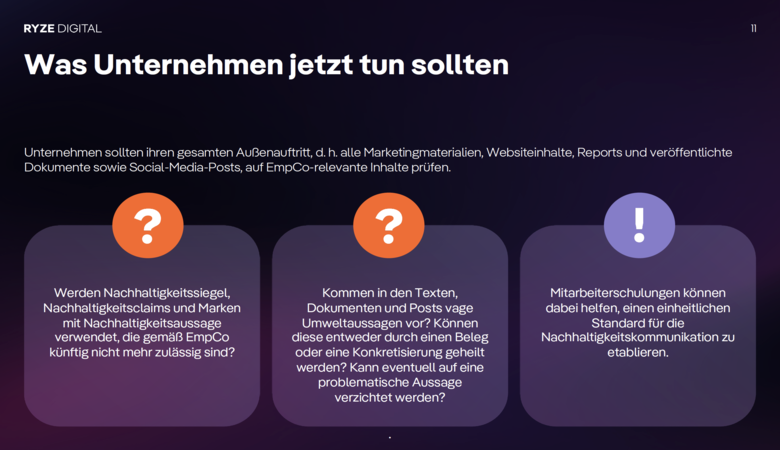
The first step is to take stock. What environmental and sustainability claims can be found on the website, in campaigns, on packaging or on social media? Reports and any advertising claims taken from them should also be included on the checklist. Sustainability-related advertising claims take priority.
The next step is to cross-check each relevant statement against its supporting evidence. What exactly does it refer to? What data or evidence is available? Does this actually cover the full scope of the claim? Depending on the outcome, a statement can be made more specific, supplemented with appropriate information, or it may need to be removed.
To avoid having to go through the same questions all over again with every publication, clear responsibilities and approval processes are helpful. Marketing and sustainability management should document the supporting evidence alongside the texts and seek legal expertise in cases of doubt. Training sessions and a communication guide facilitate day-to-day implementation.
Competitors and eligible trade associations may take action against unauthorised statements. This may result in warning letters and injunctions, which entail costs and the need for changes at short notice. Anyone who subsequently breaches a declaration of discontinuance subject to a penalty clause also risks contractual penalties.
Under certain circumstances, substantial fines may also be imposed. In the case of certain widespread cross-border infringements, these fines may amount to up to four per cent of the relevant annual turnover as part of coordinated regulatory action. This refers to turnover in the EU Member States concerned. This upper limit therefore does not automatically apply to every inaccurate environmental claim.
Furthermore, claims suspected of being greenwashing can lead to reputational damage.
The EmpCo guidelines tighten the requirements for environmental and sustainability claims in corporate communications. We explain what matters most now and how to ensure that sustainability communications are robust and credible.
Many companies face a practical challenge. Over the years, large volumes of content have been generated, spread across various channels and managed by different people. Furthermore, new content is constantly being created, which must comply with EmpCo requirements in future. This is where GLIA, RYZE’s ‘Green Legal Integrity Assistant’, comes in.
The AI assistant analyses reports, website content, PR material and campaign texts for potential greenwashing risks. It highlights critical phrasing, points out missing data or evidence, and suggests improvements. This enables a more targeted identification of areas requiring action, even when dealing with extensive volumes of text.
RYZE supplements this analysis with consultancy and editorial support. Together with the companies, we examine the statements that raise concerns, refine the wording and develop guidelines for future sustainability communications. GLIA supports the preliminary review. The technical assessment and the necessary legal review remain part of the process. Legal expertise can be drawn upon for legal matters.
In this way, general green promises are transformed into concrete statements that clearly convey what a company actually achieves.
