 RYZE AI Suite AI solutions for efficiency and productivity

Recap Corporate Reporting Conference 2024
Date
 Corporate Reporting Holistic reports with impact and efficiency
  Sustainability Effective communication of sustainability
  Internal & External Communications Communication that moves people
  Employee Experience Communication that brings people together
  Film & Animation Studio Films and animations that convince
  Digital Experience Platforms & Websites Websites and platforms for strong brands
  Social Media & Performance Marketing Campaigns that deliver results
  CRM, marketing & sales with HubSpot Consultancy and systems for your growth
  Product & Digital Data Services PIM & DAM solutions for consistent product data
Happy anniversary! On 25 June 2024, our Corporate Reporting Conference (CRC) celebrated its tenth anniversary. Digitally moderated by our CEO Philipp Mann, the conference once again offered an exciting mix of specialist presentations, live demonstrations and best practices.
In keeping with the motto "What's next?", the focus was on the latest trends and developments in digital reporting. A varied programme with four presentations was put together for the participants:
The content was presented by the speakers:
Philipp Mann (CEO, RYZE Digital)
Patrick Weiser (Managing Director Creative, RYZE Digital)
Matthias Frescha (Managing Director Tech, RYZE Digital)
Patrick Winter (Senior Investor Relations Manager, Lufthansa)
Christian Knoll (Investor Relations Publications, DHL)
Patrick Sievering (Capital Markets & Accounting Advisory Services, PwC)
Our experts contributed a wealth of expertise to the event and encouraged interactive dialogue. Participants had the opportunity to ask questions via chat and take part in surveys. The result was a three-hour event that provided valuable information and insights.
As usual, the conference opened with the latest results of our DAX 40 2024 trend monitor. This much is clear: the reporting landscape is evolving rapidly and is increasingly adapting to modern requirements. Digital first is the order of the day. Nevertheless, many of the DAX 40 companies still rely exclusively on PDFs in their media portfolio.


But more data, more problems! PDF reports are reaching their limits due to the increasing volume of reporting. Particularly in view of the forthcoming CSRD Directive, which requires standardised sustainability reporting, a change of course towards HTML reports is recommended.
There are certainly role models. In practice, there is a considerable variety of possible partial HTML and full HTML reports:
You can find further interesting insights into narrative content outsourcing in reporting or the transformation possibilities offered by AI in our blog article on the DAX 40 2024 trend monitor.

Full HTML, partial HTML or PDF? What about the performance of online reports? Download the analysis of the reporting trends of the DAX 40 companies now free of charge.
Our discussion panel provided exciting insights into the reporting strategies of Lufthansa and DHL. Both companies have decided to switch their annual reports to full HTML. But what prompted them to take this step?


Patrick Winter explained that a breath of fresh air should be brought into financial publications. "We believe that full HTML reports will be the leading medium in the future," he emphasised. The digital Lufthansa annual report includes an appealing landing page for quick access and an intuitive user interface with numerous quick-access tools. This was rewarded with positive user feedback and a frequency of use comparable to that of the PDFs.
Christian Knoll from DHL reported that the size of annual reports is increasingly threatening to become unreadable. "Upcoming regulations will make the whole thing even more extensive." The new DHL Reporting Hub therefore serves as a central point of contact for all relevant reporting data. DHL Reporting HubThe advantages are obvious: a full HTML report makes it easier to find information, enables a good connection to disclosure management systems and is much easier to read in a responsive, mobile format than static PDFs.

User behaviour for online business reports
The user figures also show that there is acceptance and interaction with HTML reports. Full HTML reports are not only used as a channel for PDFs, but also offer a unique user experience as a functional reporting hub.


But what happens next? Where can the project process for full HTML reports already be optimised? We know the most important levers:
Further necessary transformation steps result from the new CSRD directive. The new non-financial universe will take up significantly more space than in previous years. Systems and processes that are established in financial reporting must therefore also find their way into the ESG area.
It pays to be early! Companies are well advised to align their reporting systems and processes with the new requirements in good time. Artificial intelligence already promises exciting approaches today: Automated text generation and text labelling as well as the aggregation of content from different sources offer opportunities for efficient sustainability reporting.
In conclusion, questions remain: Why is the digital transformation in reporting not progressing faster? Why do PDF reports continue to dominate? Regulatory requirements such as the CSRD are making reports increasingly complex. PDFs as static answers to this complexity are no longer sufficient. They are neither reader-friendly for smaller viewports, nor do they offer interactivity or allow accessible filtering for specific content.
We therefore present the annual report of tomorrow - modern and user-centred. Interactive access and intelligent links between topics make it easier to navigate between report structures and standards. Related content can be viewed together at a glance. Various modes and features such as Quick Access, an Explore mode, a Collect mode and a report AI enable users to quickly and productively search for content with real added value.
A new era needs a new kind of annual report
Music of the future? Not at all! All the tools are already available and can be implemented in future reports. From now on, it's time to move away from the static annual report to the modern, fully automated reporting hub. So what are we waiting for?

Since 2014, we have been analysing the annual reports of DAX companies according to various criteria and evaluating the qualitative and quantitative reporting trends that emerge. This is how the DAX companies performed in their reporting in 2021.
More information

The second virtual Corporate Reporting Conference on 28 June 2022 is behind us and we look back on presentations, insights and trends in corporate reporting.
More information
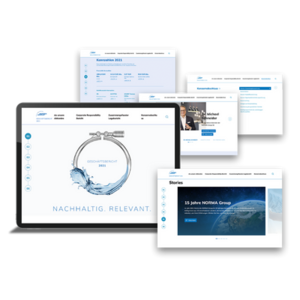
Investor Relations at NORMA Group is breaking new ground in reporting. In addition to the usual interactive PDF, the 2021 Annual Report is now also available in fully digitalised form.
More information

Integrated corporate reporting is becoming increasingly complex: different standards, software and languages make the annual report a huge project. To make this easier, RYZE offers an effective tool: the RYZE Reporting Hub.
More information
RYZE Digital's Corporate Reporting Conference 2023 (CRC 2023) is already behind us again this year, but its exciting messages about annual and sustainability reports remain relevant: a brief review and a summary - for everyone who missed our digital conference.
More information

Hard facts and figures dominate, there is no more room for image communication: this seems to have been the trend in annual reports in recent years. And the sustainability report is facing the same development thanks to CSRD. Is this the end for image issues and good stories? We say no.
More information

Annual reports are time-consuming and require coordination. Compliance with legal requirements and submission deadlines puts a strain on employees. The RYZE Reporting Hub and Workiva simplify reporting and combine the strengths of PDF reports and full HTML reports.
More information

An annual report is more than just figures - it tells the company's story and strengthens its image. The RYZE Reporting Hub simplifies and automates this complex process and enables gripping storytelling thanks to synergies with Ecoma.
More information